Approved Duty Structure in Finance Act 2026
The Government of Pakistan has officially approved a revised duty structure for imported vehicles under the Finance Act 2026. The new tariff regime significantly reduces import duties on several vehicle categories while restructuring customs taxes as part of the government’s broader tariff reform agenda.
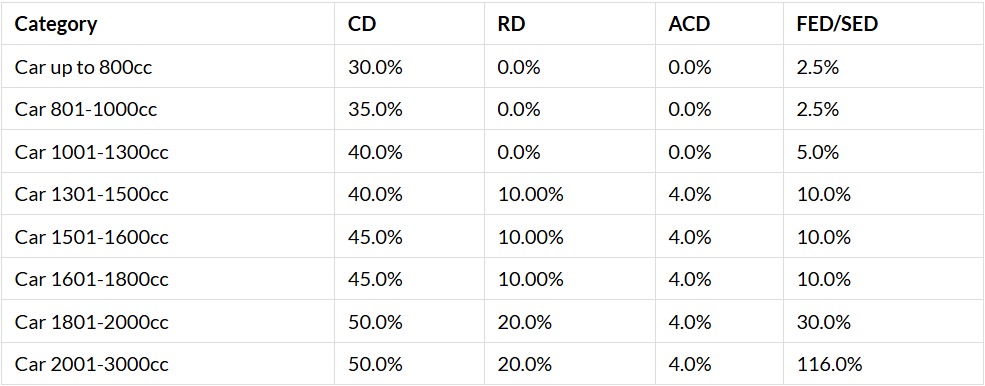
The updated structure applies different rates of Customs Duty (CD), Regulatory Duty (RD), Additional Customs Duty (ACD), and Federal Excise Duty/Special Excise Duty (FED/SED) based on engine capacity.
The reforms are aimed at simplifying Pakistan’s tariff system, encouraging competition in the auto sector, and gradually reducing protection for locally assembled vehicles.
Major Changes Introduced
Lower Customs Duty for Small Cars
The Finance Act reduces Customs Duty for smaller engine vehicles:
Up to 800cc: 30%
801–1000cc: 35%
1001–1300cc: 40%
These reductions are expected to make imported compact vehicles relatively more affordable compared to previous years.
No Regulatory Duty up to 1300cc
Vehicles with engines up to 1300cc will continue to enjoy:
0% Regulatory Duty
0% Additional Customs Duty
This keeps the effective tax burden lower for economy-class vehicles.
Mid-Size Vehicles Continue to Pay RD
For vehicles between 1301cc and 1800cc, the government has retained:
10% Regulatory Duty
4% Additional Customs Duty
10% FED
These vehicles still receive relief compared with the previous duty regime while maintaining moderate import protection.
Higher Taxes on Luxury Vehicles
Luxury vehicles continue to attract significantly higher taxes.
For example:
1801–2000cc
Customs Duty: 50%
Regulatory Duty: 20%
Additional Customs Duty: 4%
FED/SED: 30%
2001–3000cc
Customs Duty: 50%
Regulatory Duty: 20%
Additional Customs Duty: 4%
FED/SED: 116%
The exceptionally high FED/SED is intended to discourage imports of large-engine luxury vehicles while increasing government revenue.
Impact on Car Buyers
The revised duty structure could have several effects:
Lower landed cost for small imported vehicles.
Increased competition for locally assembled cars.
Better availability of imported Japanese and international models.
Luxury vehicles remain heavily taxed due to high FED/SED.
The gradual tariff reduction aligns with Pakistan’s broader customs reform strategy.
Final ThoughtsThe approved duty structure under the Finance Act 2026 marks one of the most notable reforms in Pakistan’s automobile import policy in recent years. While smaller and mid-sized vehicles benefit from reduced customs duties, premium and luxury vehicles continue to face substantial taxation.
Consumers planning to import a vehicle should carefully calculate the combined impact of Customs Duty, Regulatory Duty, Additional Customs Duty, and FED/SED before making a purchase decision, as these taxes collectively determine the final landed cost.